Panacur Powerpac Equine Dewormer Pet Medication
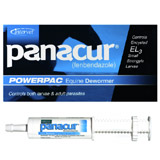
- Farm Animal
- Availability: OTC
- Active Ingredient(s):
Fenbendazole (10%)
- What is Panacur Powerpac Equine Dewormer used for?
Panacur is an equine dewormer paste indicated for the control of large strongyles, encysted early third stage, late third stage and fourth stage cyathostome larvae, small strongyles, pinworms, ascarids, and arteritis caused by fourth stage larvae of S. vulgaris in horses.
- How Panacur Powerpac Equine Dewormer should be used?
Panacur Paste 10% is administered orally at a rate of 2.3mg/lb for the control of large strongyles, small strongyles and pinworms. One oral syringe will deworm a 2,500 lb horse. For foals and weanlings (less than 18 months of age) where ascarids are a common problem, the recommended dose is 4.6mg/lb and one oral syringe will deworm a 1,250 lb horse. For control of encysted early third stage, late third stage and fourth stage cyathastome larvae, and fourth stage larvae of S. vulgaris, the recommended dose is 4.6mg/lb for 5 consecutive days using one oral syringe for each 1,250 lbs of body weight per day. A recommended deworming program in the U.S. is December 1, February 1, April 1, June 1, August 1, and October 1. April and October are the recommended dates when the 5 day regimen for the control of the migrating larvae of S. vulgaris should be performed.
- What are the side effects?
With higher doses, the lethal action of fenbendazole may cause the release of antigens by the dying parasites. This phenomenon may result in either a local or systemic hypersensitive reaction. These reactions should be treated symptomatically. Panacur Paste 10% is safe to use in pregnant mares during all stages of gestation. No adverse effects on reproductivity in stallions have been detected. The recommended dose for control of fourth stage larvae of S. vulgaris, 4.6mg/lb daily for 5 consecutive days, has not been evaluated for safety in stallions or pregnant mares. There are no known contraindications for the use of Panacur Paste 10% in horses.
- What special precautions are there?
This product is for use in horses only. Do not use in horses intended for food. When using concomitantly with trichlorfon (Combot®), refer to the manufacturer’s labels for use and cautions with trichlorfon.
- In the event of overdose?
Contact your veterinarian or veterinary emergency room.
- How should I store Panacur Powerpac Equine Dewormer?
Store the container at room temperature. Keep out of the reach of children and pets.
Disclaimer: The information on this site is for educational purposes only and should NOT be considered veterinary advice. Any veterinary questions should be referred to your veterinarian. This information is NOT to be used for diagnosis or treatment of your pet. Please make your own inquiries with your veterinarian for the suitability of a product for your pet.