
We could just be positive by saying "good dog" however, there are some potential problems that can arise. We will eventually use a different tone depending on the mood we are in, which means that this is not a consistent sound; dogs are very sensitive to body language and tone so this will produce mixed signals depending on your mood, and has the possibility of complicating the training!
The other problem is timing - by the time we say "good dog", the dog may have stopped the positive behavior and moved on to something else. Dogs do not have the reasoning power to determine which one of the behaviors is the good one, so again they receive a mixed signal.
Where do you start with Clicker Training?
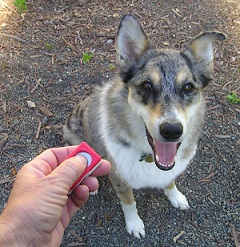
The most important thing you need in clicker training is your clicker! The next things you'll need are some dog treats. The ideal treats should be, easy to eat, and tasty - something that will really make his mouth water! They must be quick to eat because this is a dynamic, fast paced way to train, so you don't want your dog wasting 15 or 20 minutes crunching through huge biscuits! Cheese is an excellent treat, cut up into small pieces it is irresistible to most dogs, cooked sausages works well also but is a little messier. The treats need to be easily accessible - either in a loose pocket or a bag carried around your waist.
You should start somewhere with minimal distractions. Our first goal is to show the dog the meaning of the clicker. Stand directly in front of him, click ONCE and give him a treat. At this point, the dog doesn't have to do any work for his treat - he just needs to learn the association of the 'click' and treat routine. Spend some time doing a 'click', then treat. Generally give 1 treat but very occasionally, 'jackpot' with a handful of treats. Being unpredictable is a great trick to use with dogs - he'll eventually work harder, because although he knows he'll get a treat anyway, it'll always be in the back of his mind that he might just get 5 treats if he does something extra special!
It will not take long for him to learn that a 'click' means that a treat it coming - you will see the recognition in his behavior. His ears will point up at the 'click' sound, he may get excited, his behavior will show that he expects a treat following the 'click' sound.
The 3 most important clicker training rules
1. ALWAYS treat after a click - even if you've done so accidentally. The dog must have absolute faith in the 'click means treat' routine. Do not give your children the clicker to play with as a toy - even if they're in a different room to the dog, he WILL hear it and will be very tormented and confused if his treats don't follow. The clicker is the dog's toy and no-one else's!!
2. Only click ONCE. Don't get overly excited when he completes complicated commands and 'click, click, click' - this will take the consistency out of the 'click' and treat routine. One click is always sufficient!!
3. Keep training sessions short and sweet, preferably around five to seven minutes, any longer and it could seem more like a job and less like fun. They should be enjoyable for both of you; fun for him because he's getting lots of treats and is using his brain, and fun for you because it is far easier to train him than you could have ever imagined but remember keep it fun by keeping it short!